
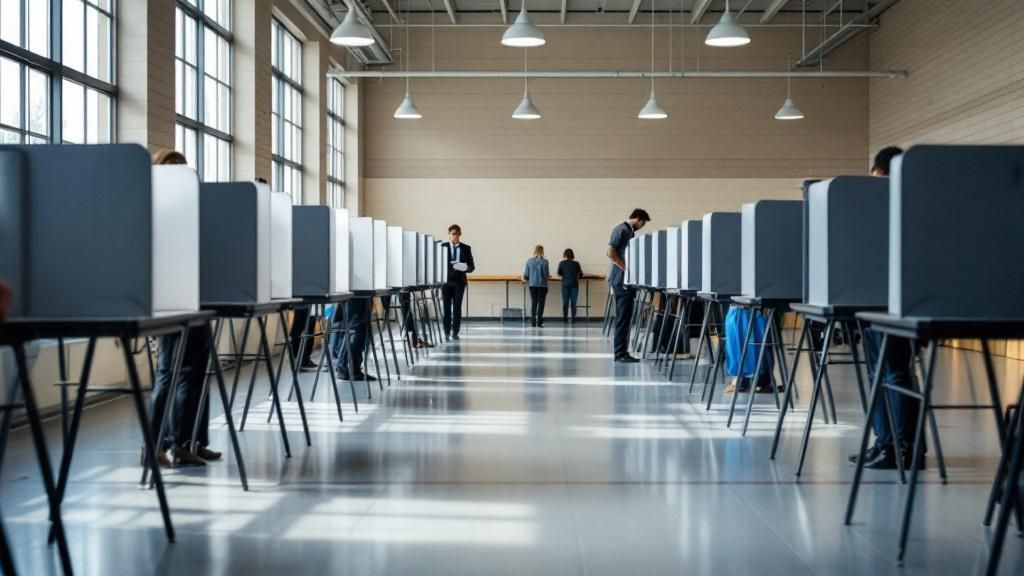
Police have completed their examination of allegations of irregular voting at the Gorton and Denton by-election, uncovering no evidence of misconduct. Greater Manchester Police stated there was “no evidence to suggest any aim to persuade or refrain a person from voting” following the poll held on 26 February, when Green candidate Hannah Spencer won the traditionally Labour safe seat. The investigation was initiated after Reform UK leader Nigel Farage made allegations of “voting by family members” — where relatives allegedly sway how people vote their ballots — to both the constabulary and the Electoral Commission. However, Farage has dismissed the findings, characterising the outcome as an “establishment whitewash” and calling for greater oversight and accountability in electoral processes.
Investigation Concludes Without Evidence
Greater Manchester Police carried out interviews with officers deployed to all 45 polling locations throughout the constituency, none of whom reported any incidents of electoral intimidation or improper conduct. The force also reviewed CCTV footage from the four polling stations where cameras were operational, identifying no visual evidence of anyone influencing or influencing voters regarding their ballot choices. Of the 45 venues, 41 had intentionally switched off CCTV systems on election day to protect ballot secrecy in accordance with official electoral guidance. Police stressed that Democracy Volunteers observers, who had raised the concerns, were unable to provide specific descriptions of individuals allegedly involved or exact times of the alleged incidents.
The four Democracy Volunteers observers attending polling day documented approximately 32 instances across 15 stations where multiple voters entered booths simultaneously or individuals appeared to look over voters’ shoulders. However, they made no claims of any spoken directions or bodily actions indicating coercion. Police stated that without such corroborating information—accounts, times, or recorded proof of actual direction—there was no viable avenue for investigation to pursue. The absence of supporting evidence from polling station staff or CCTV footage effectively closed the inquiry, leading officers to conclude the allegations lacked sufficient foundation.
- All 45 polling station officers interviewed reported zero coercion allegations
- Only four sites had CCTV; footage showed no signs of wrongdoing
- Observers failed to offer details or timeframes of alleged incidents
- No verbal instructions or physical coercion was claimed by any observer
What Is Family-Based Voting and Why It Is Important
Family voting refers to the practice of a person attempting to influence their voting decision, typically by going with them to the polling station or directing their ballot choices. This constitutes a serious breach of electoral law under the Ballot Secrecy Act 2023, which specifically protects each voter’s right to cast their votes in total privacy and free from intimidation or coercion. The conduct undermines the fundamental democratic principle that every voter should make independent decisions free from external pressure or influence from family members or any other person.
Allegations of group voting by household members can substantially undermine voter trust in the integrity of elections, particularly in constituencies with diverse communities where such concerns are more likely to surface. The Gorton and Denton by-election, taking place on 26 February and won by Green Party candidate Hannah Spencer, drew such allegations after reports from independent election observers. These accusations prompted official inquiries by Greater Manchester Police and the Electoral Commission alike, underlining how seriously authorities handle potential breaches of voting secrecy and the greater scrutiny surrounding contemporary election procedures.
Legal Framework and Voting Protections
The Ballot Secrecy Act 2023 provides the main statutory protection from family voting and voter coercion in the United Kingdom. The legislation strictly forbids any attempt to influence direct, or refrain a person from voting in a particular manner, with consequences for those convicted of such violations. Polling stations are designed with privacy booths to allow voters to mark their ballots in private, and polling station staff are instructed to act if they identify suspected infringements of voting secrecy.
Electoral safeguards also encompass the deployment of independent election observers, such as those offered by Democracy Volunteers, who observe polling day activities to identify anomalies. CCTV systems can be placed at voting locations, though their application must be properly calibrated against the requirement to maintain electoral privacy. Greater Manchester Police’s investigation into the Gorton and Denton claims demonstrated how these several levels of scrutiny—from experienced officials to external watchers to police examination—function collectively to protect electoral integrity.
The Witness Accounts and Law Enforcement Action
The Democracy Volunteers organisation, an independent and non-partisan electoral monitoring body, filed reports after the Gorton and Denton by-election drawing attention to what they described as “extremely high” instances of familial voting. The organisation’s four trained observers documented instances of multiple voters entering polling booths at the same time and people appearing to observe over voters’ shoulders at 15 different polling stations. Democracy Volunteers maintained that their observations were conducted in good faith by experienced professionals committed to electoral transparency. The group’s findings prompted Nigel Farage, leader of Reform UK, to file formal complaints with both Greater Manchester Police and the Electoral Commission, seeking investigation into possible violations of electoral secrecy.
Greater Manchester Police’s inquiry involved interviewing election staff across all 45 venues in the constituency, as well as the four Democracy Volunteers observers present on polling day. Officers examined CCTV recordings that existed from the limited number of stations where cameras were operational, though 41 of the 45 stations had not enabled CCTV systems to maintain ballot secrecy in line with official guidance. Police determined that the observations, although recorded by qualified observers, had insufficient key evidence required to establish any actual misconduct or intent to affect how people voted. The absence of verbal instructions, physical coercion, or detailed descriptions of individuals allegedly involved meant police found no reasonable grounds to bring charges or further investigation.
| Finding | Details |
|---|---|
| Polling Stations Checked | All 45 polling stations in Gorton and Denton constituency were visited and officers interviewed |
| CCTV Availability | Only 4 of 45 stations had CCTV activated; 41 stations had cameras disabled to protect ballot secrecy |
| Reported Incidents | Democracy Volunteers estimated 32 occasions of multiple voters in booths or shoulder-looking across 15 stations |
| Evidence of Coercion | No verbal instructions or physical conduct indicating direction or coercion was observed or documented |
| Police Conclusion | No evidence of intent to influence voting behaviour; investigation closed with no charges recommended |
Lacking Documentation and Deadlines
A considerable limitation in the examination was the shortage of detailed documentation from Democracy Volunteers observers regarding the individuals and timing involved in the suspected family voting incidents. Whilst the observers offered eyewitness accounts to police, they were unable to provide details about those allegedly participating in improper conduct or precise timings of when incidents took place. This lack of specificity significantly impeded police efforts to cross-reference observations with existing CCTV footage or to speak with individuals who could have been present. Without specific identifiers or time markers, investigators could not establish a trustworthy audit trail connecting specific allegations to particular voters or locations within polling stations.
The lack of documented incidents contemporaneously during polling day constituted a substantial documentary void. Electoral observation protocols typically require monitors to document occurrences with exact particulars to allow for later verification and investigation. The Democracy Volunteers observers’ reliance on hindsight recall, alongside their lack of specific names, times, or corroborating details, gave police with inadequate basis to conduct additional investigations. Greater Manchester Police’s finding that there was no remaining reasonable line of enquiry demonstrated this absence of documentation, making it impossible to determine whether the noted actions amounted to genuine wrongdoing or just innocent circumstance.
Contested Claims and Political Repercussions
The police inquiry findings has intensified the political row surrounding the by-election outcome. Nigel Farage dismissed Greater Manchester Police’s findings as an “establishment whitewash,” arguing that the force had failed to conduct a sufficiently rigorous inquiry. He maintained that the matter demanded “genuine oversight, genuine accountability and the courage to admit when something isn’t right,” implying that the authorities had prioritised wrapping up the case over investigating actual misconduct. Farage’s remarks demonstrated Reform UK’s wider discontent with the outcome, which saw Green Party candidate Hannah Spencer win the traditionally Labour-held Gorton and Denton seat on 26 February.
In sharp contrast, the Green Party has characterised Reform’s allegations as a sore loser’s attempt to undermine a valid election result. A Green Party spokesperson labelled the claims as “a stubborn rejection to recognise a evident outcome,” rejecting them as bad faith attempts to delegitimise Spencer’s victory. Meanwhile, Democracy Volunteers, the election monitoring body that originally highlighted concerns about voting patterns within families, upheld the credibility of its findings, stating that its report documented “observations conducted in good faith by trained and experienced, non-partisan and independent observers on polling day.” The organisation’s stance suggests it upholds its findings despite scepticism from police.
- Farage calls for proper oversight and accountability in future electoral investigations and monitoring procedures.
- Green Party describes allegations as childish effort to challenge Hannah Spencer’s lawful electoral win.
- Democracy Volunteers maintains that observers acted in good faith with appropriate qualifications and expertise.
- Police termination of inquiry marks considerable friction between various parties in election administration.
- Dispute underscores broader concerns about electoral monitoring procedures and record-keeping requirements.
Electoral Commission’s Response and Forthcoming Steps
The Electoral Commission, which received a distinct submission from Nigel Farage together with Greater Manchester Police, has yet to release its formal findings on the matter. The independent regulator’s investigation runs parallel the police inquiry and may take considerably longer to conclude, given the Commission’s typically thorough handling of election-related grievances. The result of this inquiry could be consequential in determining whether systemic changes to electoral oversight procedures are warranted across future ballots in the UK.
The dispute has exposed potential gaps in how electoral observers record and communicate problems during election day procedures. With only four Democracy Volunteers monitoring staff deployed to 45 voting centres, doubts have surfaced about adequate coverage and the consistency of reporting protocols. Electoral authorities may face pressure to set out firmer procedures for observer conduct, strengthened documentation procedures, and upgraded surveillance systems that address security considerations with the necessity for adequate accountability and accountability in democratic processes.
